

4.1 NOTAMs, Wake Turbulence, and Altimeters
Lesson Progress
Not completed
This lesson covers essential pre-flight knowledge, the invisible hazard of wake turbulence, and how barometric altimeters work.
1. NOTAMs (Notice to Airmen)
A NOTAM is a notice containing information about the establishment, condition, or change in any aeronautical facility, service, procedure, or hazard, the timely knowledge of which is essential to pilot.
- Purpose: To provide timely knowledge essential to pilots. You must check NOTAMs as part of your pre-flight preparations.
- Scope: A NOTAM can apply to the entire country, a large area (for example, a military exercise or forest fire), or a single airport (for example, an airshow or temporary runway closure).
- Hang Gliding: Some hang glider sites request that NOTAMs be issued to alert the flying community that hang gliding activities are taking place.
You can find current NOTAMs on NavCanada’s flight planning page.
2. Wake Turbulence
Wake turbulence is a hazardous by-product of lift caused by wing tip vortices. As a lift-producing airfoil passes through the air, the airflow rotates up and back from each wing tip, producing two distinct, counter-rotating vortices.
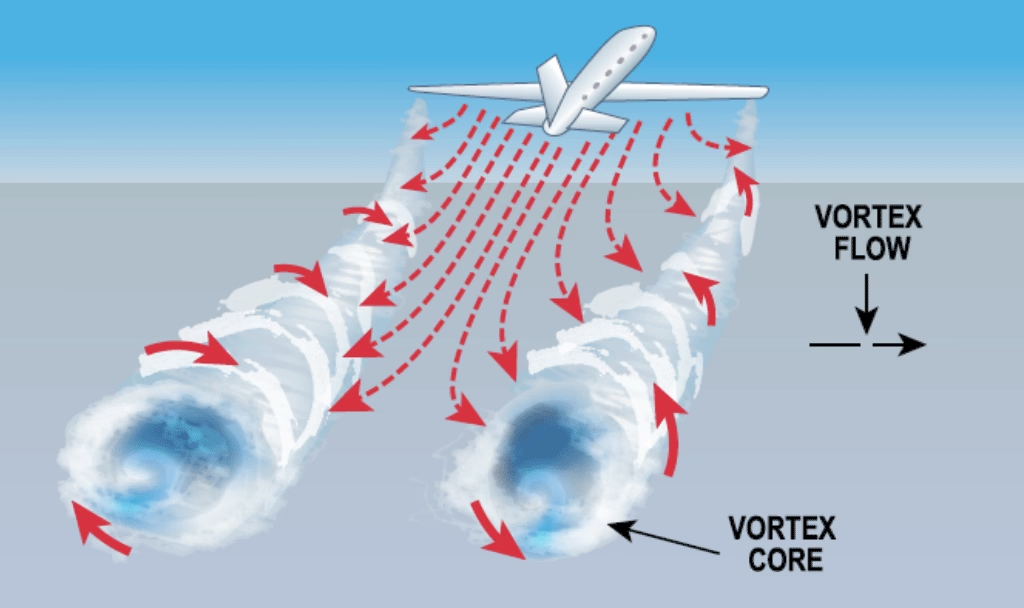
Key Characteristics of Wake Turbulence
- When it happens: Vortices start when an aircraft’s nose wheel leaves the ground (rotation) on take-off, and continue until the nose wheel touches down on landing.
- Intensity: The heavier and slower the aircraft is, the greater the intensity of the vortex. Wake turbulence is usually most violent when large aircraft are climbing out from take-off or approaching to land.
- Movement: Vortices sink below and behind the generating aircraft. Because they drift with the wind, they are not always found directly behind the aircraft.
- Persistence: Vortices can persist for several minutes, especially in calm wind conditions.
The Danger to Hang Gliders
Flight behind heavy aircraft may result in unresponsive controls, loss of control, and structural damage. This danger increases as the size and weight of your aircraft decreases. Therefore, all other aircraft produce hazardous wake turbulence for a hang glider. You should always avoid flying behind and below other aircraft.
3. Altimeters
An altimeter is an aneroid barometer (a barometer without liquid) that calculates altitude by measuring atmospheric pressure. It works on a simple principle: as you go higher, the weight of the air above you consistently decreases.
Why Barometric Pressure instead of GPS?
While modern GPS gives you an accurate geometric height, aviation relies on barometric altimeters as primary flight instruments for two critical reasons:
- Unfailing Reliability: Barometric altimeters are mechanical and self-contained. They don’t require power or rely on satellite signals.
- Standardized Vertical Separation: Using a shared pressure setting ensures all aircraft maintain consistent vertical separation, even as their true altitudes fluctuate with the weather.
Calibration Rules
Under Standard Air Conditions of 15°C, the weight of a column of air one square inch in area is 14.7 lb at sea level. This pressure is recorded on a barometer as 29.92 inches of mercury (inHg). Air conditions in any particular area rarely exhibit the Standard Air Conditions, which means altimeters often require adjustment for flight:
- Local Flights (HG/PG): Hang glider pilots can adjust their altimeter to match the launch elevation before a flight.
- Cross-Country Flights: An altimeter will drift with weather and pressure changes. Pilots flying below 18,000 feet must update their altimeters to the local pressure setting (provided by ATC or weather stations) to guarantee accurate terrain clearance.
- High Altitudes (Standard Pressure Region): At 18,000 feet and above, terrain clearance is no longer a factor. Instead, the law requires all pilots to lock their altimeters to the standard 29.92 inHg. By forcing every high-altitude aircraft to reference the exact same pressure baseline, air traffic control ensures perfect vertical separation across the entire airspace, immune to local weather variations.